ReVeAL considers the implementation of UVAR measures a necessary part of a wider transition management challenge.
In view of this, “Cross-cutting Themes” are aspects that are common to all Urban Vehicle Access Regulations and that need to be comprehensively and co-ordinately considered when implementing them.
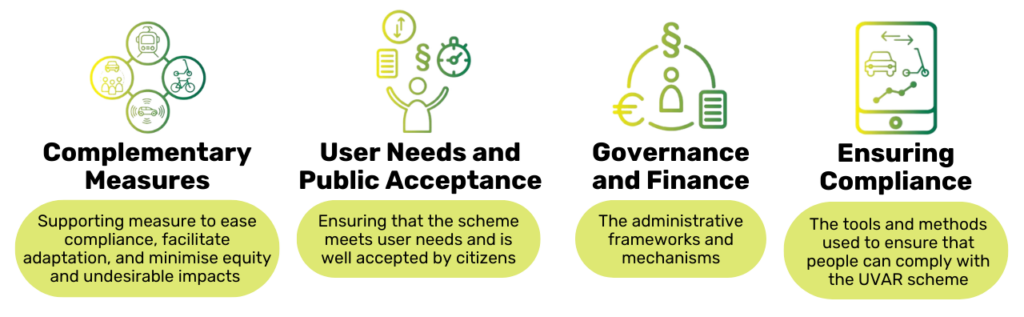
ReVeAL has grouped these into four topics:
 Supportive Mobility Measures
The mobility services that exist and are already planned in a city affect what UVARs can be developed, as well as whether they will be successful or not. Cities’ ongoing and future mobility plans and UVARs need to be considered as harmonised parts of one organism.
 User Needs and Public Acceptance
An UVAR may not be universally welcome, but it will only be successful when generally accepted and meeting the mobility needs of its city of application. Knowing its problems and users and involving stakeholders are all other additional aspects that can increase the scheme’s success.
 Governance and Financing
The administrative frameworks and mechanisms of a city (which include its decision-making context, legal and policy frameworks, and more), as well as its financial arrangements for funding UVAR measures and using the resulting revenue streams, influence the development of an UVAR.
 Ensuring Compliance
The choice of tools and methods to ensure that users can easily understand how to comply with an UVAR and that compliance is consistently enforced depends on many aspects, as does the type – technological or manual in nature – that is most appropriate for each city.